SM-RT Solutions - Your Workplace Safety Trainer
Hoisting and Rigging
Overhead Service Crane
Overhead Service Crane
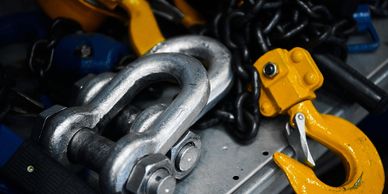
In this introductory course, participants are taught about relevant legislation in the OHSA, Regulations, and ASME B-30.9, in a way that doesn’t get bogged down in legal speak but integrates the information into practical and meaningful terms.
This program covers the following topics:
• Identifying rigging hazards, their contributing factors, and associated controls
• Discussing the roles and responsibilities of all involved
• Pre-Use inspections and rejection criteria
• Rigging gear selection criteria and principles of safe application
Overhead Service Crane
Overhead Service Crane
Overhead Service Crane

Participants are taught about relevant legislation in the OHSA, Regulations, and CSA B-167, in clear language.
This program covers the following:
• Applicable legislation, hazards in the workplace, and their contributing factors
• Requirements for safe crane operation
• Capabilities and limitations of cranes
• General operation, including inspection, crane travel, raising / lowering, and load control
• This course does not cover rigging, but is available from SM-RT Solutions
0-8 Ton Mobile Crane
Overhead Service Crane
Elevated Work Platforms
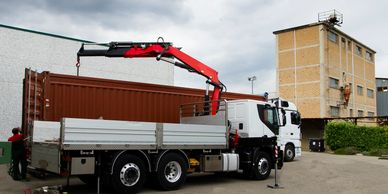
This program focusses solely on the 0-8 ton class of mobile cranes, which may be articulating / knuckle-booms, truck-mounted service cranes, industrial yard cranes identified as carrydecks, or tracked spider cranes with telescopic booms.
Legislation of the OHSA, Regulations, and CSA Z-150 is covered in practical and meaningful terms.
This program covers the following topics:
• Applicable legislation, hazards in the workplace, and their contributing factors
• Features of mobile cranes, attachments, and operational considerations
• General operation, including inspection, driving, set up, opening / stowing, load handling, and operational maintenance
• This course does not cover rigging, but it is available from SM-RT Solutions
Elevated Work Platforms
Confined Space Awareness
Elevated Work Platforms

In this course, participants are taught about the relevant legislation in the OHSA, Regulations, and CSA B-354.
This program covers the following topics for Type 1 and Type 2 EWP:
• Applicable legislation, hazards in the workplace, and their contributing factors
• Features of EWP, common applications, and operational considerations
• General operation, including inspection, driving and set-up, raising/lowering, emergency measures, and operational maintenance
Confined Space Awareness
Confined Space Awareness
Confined Space Awareness

Participants are taught about the relevant legislation in practical and meaningful terms.
This program covers the following topics:
• Identifying Confined Spaces, their hazards and controls
• Roles and responsibilities of employers, supervisors, workers, assessors, attendants, entrants, and rescuers
• The Confined Space program components and how the system works in Ontario
• A review (only) of associated work, such as Confined Space Assessing, Rescue, and Atmospheric Testing
Note that formal training in Assessing, Rescue, and Atmospheric Testing is required for anyone who is to engage in such work. SM-RT Solutions would be happy to discuss your custom training needs.
Fire Extinguisher
Confined Space Awareness
Confined Space Awareness
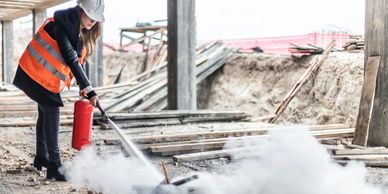
In this course, participants are taught about the relevant legislation in the Occupational Health and Safety Act, Regulations, and indirect applicable references to the Fire Code, in a way that doesn’t get bogged down in legal speak but integrates the information into practical and meaningful terms.
This program covers the following topics:
• The Fire Triangle (sometimes referred to as the tetrahedron) and the science of fire
• Classes of fires and considerations associated with them
• Types of extinguishers and considerations associated with them
• Fire extinguisher inspections
• What to do in case of a fire
• Proper fire extinguisher use and technique
Workplace Inspections
Supervisory Due Diligence
Supervisory Due Diligence

Third party perspective and extensive knowledge of construction, industrial, and mining environments will aid employers in looking beyond the obvious. This is a great service which can be provided on a one-off or regularly scheduled frequency.
Site visits are designed to be educational to front line supervision, thereby augmenting their knowledge base and due diligence.
Supervisory Due Diligence
Supervisory Due Diligence
Supervisory Due Diligence

Front line supervisors are often promoted into such roles as a result of their work ethic, organizational abilities, technical skills, etc. but are often ill-equipped to understand and employ their legislated responsibilities under health and safety law.
It is a legal responsibility for employers to ensure that workers are overseen by competent supervision.
This introductory program explores the basic concepts of supervisory due diligence, briefly looking at the following:
• The Occupational Health and Safety Act, regulations, and company policy / procedure
• Key roles and responsibilities, and the Internal Responsibility System
• Hazards and risk, contributing factors, and the hierarchy of controls
• Investigations, inspections, and job task observations, and the concept of proactive vs. reactive measures